


Why Shift from Traditional Lending Systems to Digital Lending Process?
- Digital Marketing
- 2 hours ago
- 4 min read


Money is a factor that is highly involved in our day-to-day life. To fulfil our family’s needs, dreams, and desires, we often feel financially stretched. That’s when lending and borrowing come into the picture. The process of the lending and borrowing system dates back to the times when humans started living in society and incorporated money into their daily interactions. Borrowing money allows a person to receive funds in advance when needed and repay them over a set period.
Today, the world has witnessed a drastic change in how humans communicate about finances. At the same time, different ways of borrowing from banks, credit unions, and NBFCs remain reliable options.
Stick with us to the end of this blog, where we will examine the pros and cons of traditional and digital lending systems.
Difference Between Traditional Lending and Digital Lending
The table below shows the key differences between traditional and digital lending.
Features | Digital Lending | Traditional Lending |
Definition | Loans are processed digitally through mobile apps or websites using automated systems and digital verifications. | Loans are processed through physical branches, with extensive paperwork and manual verification. |
Application Process | Fully online with digital document upload and eKYC. | Requires branch visits, physical forms, and manual document submission. |
Interest Rates | May vary depending on lender, risk profile, and loan type. | Usually more standardized and regulated by banks. |
Repayment Tenure | Flexible tenure options depending on the lender and loan product. | Fixed or structured repayment schedules based on bank policies. |
Loan Type | Personal loans, consumer durable loans, BNPL, short-term loans and more. | Wide range of Loans offered, including home loans, auto loans, education loans, personal loans, and business loans. |
Need of Collaretals | Mostly unsecured for small-ticket loans. | Secured and unsecured loans are both available, depending on the loan type. |
Eligibility Criteria | Faster assessment with flexible digital evaluation methods. | More detailed eligibility checks based on income, credit history, and documentation. |
Accessibility | Easily accessible through smartphones and online platforms. | Access is mainly through bank branches and offline processes. |
Paperwork | Zero Paperwork/ Minimum Documentation | Detailed & Extensive documentation is required |
Loan Time Approval | Quick Loan approval, often within minutes | Approval may take several business days, depending on the verification |
Amount | Usually suitable for small to medium loan amounts | Suitable for both small and large loan amounts. |
Fees | Charges are usually displayed digitally for transparency. | Fees vary by institution and loan product. |
Mode of Application | Digital platforms, fintech apps, websites, and NBFC apps. | Banks, financial institutions, and branch-based applications. |
Pros of Traditional Lending
Personalised Customer Services: Traditional banking involves face-to-face interactions with customers. The customer can receive a tailored solution for their complex financial matters.
Long-Term Customer Relationship: In-person interactions during the loan application process foster long-term relationships between banks and customers.
Trust and Security: Traditional banking is widely trusted for its established, robust security measures and reliable services. Customers often feel more confident dealing with regulated financial institutions.
Regulatory compliance: Traditional banks operate under strict regulatory frameworks and compliance standards. Their adherence to financial regulations helps build customer trust and ensures transparency in lending practices.
Formal Loan Processes: Traditional lending goes through the loan application process with all necessary formalities. Whether it is documentation, the loan process, or the disbursement of funds, traditional lending ensures that everything is checked and verified before the loan is disbursed.
Cons of Traditional Lending
Potential fees: Traditional lending often entails hidden fees for loan applications. The reasons for high operational charges are the implementation of physical infrastructure and the use of manual applications.
Accessibility Limitations: Because traditional lending relies on physical branches, it limits accessibility through other quick, online channels, such as mobile applications and websites.
Lengthy Loan Processes: The loan application process is entirely in-person and manual, and it takes a few business days to proceed.
Pros of Digital Lending
Fast & Efficient: The digitalisation of the finance sector has enabled faster, more efficient loan applications and repayments. This benefit has given people the opportunity to access funds anywhere, anytime. You can also check your loan status, repayments, and associated details within seconds.
Cost-Effective: Since the loan app process, disbursement, and repayments are all conducted online, you do not need to visit a physical branch frequently. This also saves you time and travel expenses.
Regularised compliance: Digital lending platforms incorporate robust security measures and automated compliance features, ensuring the safety of borrower data and adherence to regulatory standards.
Cons of Digital Lending
Entirely Digital Communication: From the loan application process to the last repayment, all communication will be digital. Hence, the absence of person-to-person communication, which fosters long-term customer relationships, is nearly impossible to achieve.
Technical Obstacles: For digitallending, a person must have a reliable internet connection and access to online platforms via mobile devices, laptops, or personal computers.
Regulatory Challenges: The rapidly evolving nature of digital lending models can create regulatory uncertainty, requiring constant adaptation to new compliance requirements.
Why is Digital Lending gaining Popularity?
Imagine rushing to physical bank branches frequently to arrange money. In the same way, imagine being able to access funds from the comfort of your home, digitally, with minimal documentation and a user-friendly mobile application. This is the impact digitalisation has made on the finance sector, making funding easier in minutes.
With RBI-registered NBFCs, instant personal loans have become a trustworthy, genuine source that meets financial requirements in just a matter of clasping your fingers. It is not only your partner in tough times, but it also relieves your stress and financial blockages like magic.
Apply for Digital Lending at Chinmay Finlease Limited.
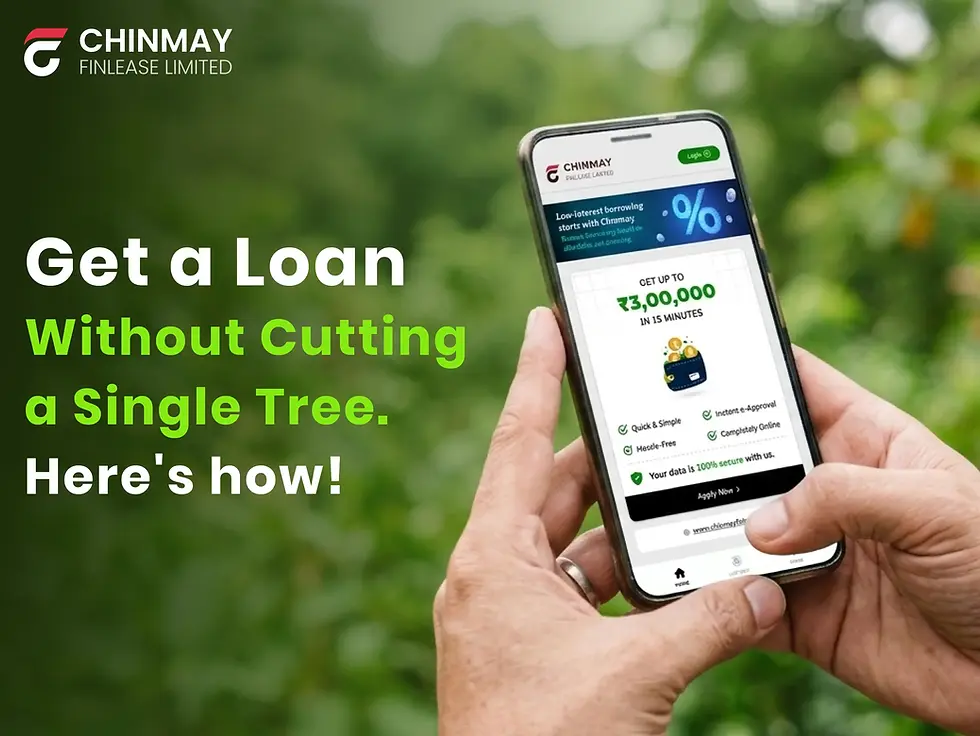
Need financial support urgently? Then, you are at the right place! Chinmay Finlease Limited is an RBI-approved NBFC offering personal loans through a personal loan app. Chinmay offers various loan products specially curated to meet each customer’s unique needs. It offers Instant personal loans, consumer durable loans, and emergency loans. With its user-friendly interface, Chinmay has simplified the loan process and curated a loan app that is easy to understand and use, so you can get funded without worrying.
Download our official quick loan application on iOS and Android and experience the smooth, hassle-free loan process.
Everything at a Glance!
This blog highlighted significant aspects of digital lending that it has offered to its customers. Staying technologically up to date and moving forward in this fast-paced world is necessary. Digital modes not only keep you updated but also improve how you manage your day-to-day, making significant life decisions go smoothly and faster. When it comes to finances, digital channels enable cost-effective, reliable lending.
Do share your valuable feedback in the comment section!
See you in the next blog!


Comments